No products in the cart.

World Sustainable Energy Days 2026 Outlook
World Sustainable Energy Days 2026 Outlook Puts Europe’s Energy Transition Into Market Focus
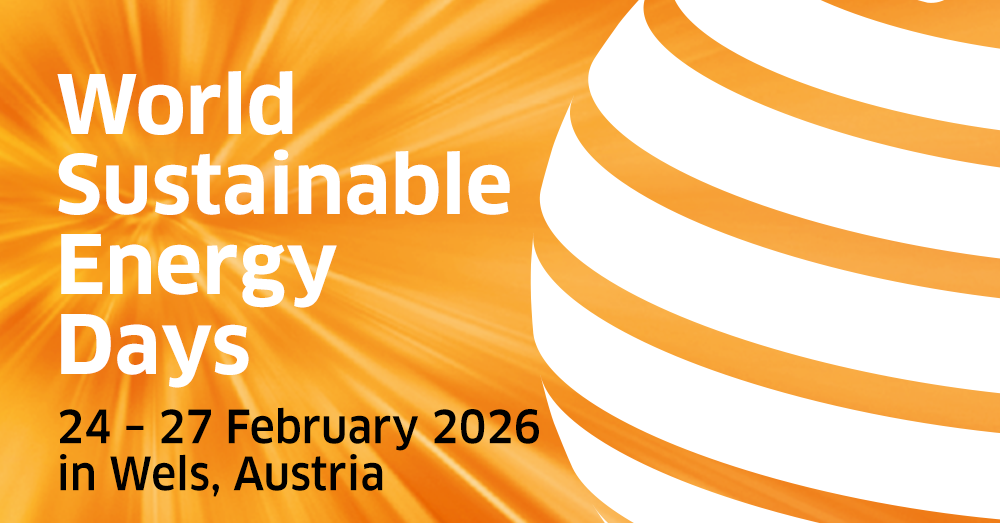
The World Sustainable Energy Days 2026 Outlook is emerging at a pivotal moment for Europe’s energy system. As power market volatility eases from crisis-era peaks, structural investment pressures across grids, renewables, industrial decarbonization and heating are intensifying. Against this backdrop, World Sustainable Energy Days (WSED) 2026, set for February 24–27, 2026 at STADTTHEATER WELS, Rainerstraße 2, 4600 Wels, Oberösterreich, Austria, is positioned as a key forum for assessing how the next phase of the energy transition will reshape business models, capital allocation and competitive dynamics.
According to the official website, https://www.wsed.at, the event is centered on sustainable energy systems. Its 2026 edition comes as Europe shifts from emergency energy security measures toward longer-term market restructuring, with implications for utilities, technology suppliers, manufacturers, policymakers and investors.
Event Profile and Strategic Context
A Market-Focused Forum in an Industrial Region
Hosted in Wels, a city in Upper Austria with strong industrial and engineering linkages, WSED 2026 is embedded in a region closely tied to manufacturing, building technologies and energy equipment value chains. The choice of venue—STADTTHEATER WELS—reflects the event’s role not merely as a policy discussion platform, but as a meeting point for sectors responsible for deploying transition technologies at scale.

While official information confirms the event dates and venue, exhibitor and attendee figures have not been publicly detailed. Nevertheless, the thematic scope indicates participation from a broad cross-section of the energy economy, including renewable energy developers, energy efficiency specialists, heating technology providers, utilities, researchers, public agencies, municipal planners and industrial energy users.
Key Sectors Likely to Shape Discussions
The World Sustainable Energy Days 2026 Outlook suggests particular focus on sectors where capital spending and policy alignment are converging:
– Renewable power, especially solar, wind and flexible generation
– Energy storage and grid integration
– Building efficiency and retrofit technologies
– Heating and cooling systems, including district energy, biomass and heat pumps
– Industrial decarbonization and process efficiency
– Energy services, digital optimization and data platforms
– Regional and public-sector energy planning
This sectoral mix underscores the event’s market relevance. As decarbonization targets tighten, the commercial viability of integrated solutions—rather than standalone technologies—is increasingly central to competitiveness.
The 2026 Energy Market Outlook
Stabilizing Power Markets, Rising System Costs
By early 2026, European wholesale power markets are expected to be more stable than during the height of supply disruptions. However, price stabilization does not equate to reduced complexity. The cost of modernizing transmission and distribution networks, integrating variable renewables, expanding storage capacity and enhancing system flexibility is becoming more visible in national budgets and utility balance sheets.
The World Sustainable Energy Days 2026 energy market outlook reflects this shift. Renewable generation continues to expand, but higher penetration levels introduce new challenges: balancing markets gain importance, curtailment risks increase in some regions and long-duration storage remains commercially underdeveloped. As a result, investor attention is moving from pure generation capacity toward integrated system solutions that combine production, flexibility and demand-side management.
Heating and Buildings Move to the Forefront
One of the defining structural trends likely to frame WSED 2026 is the rising prominence of heating, buildings and energy efficiency within European energy strategy. In many countries, heating remains among the most difficult sectors to decarbonize, particularly in older building stock and industrial heat applications.
This creates significant market opportunities for suppliers of heat pumps, district heating components, advanced insulation, biomass systems and smart building controls. At the same time, it places operational and financial pressure on installers, municipalities and property owners navigating capital constraints, labor shortages and regulatory requirements.
For Austria and neighboring Central European markets—where building performance standards and thermal energy systems are major policy priorities—these issues are expected to feature prominently. The commercial implications extend across equipment manufacturing, project development and financing structures.
Industrial Decarbonization Becomes Investment-Driven
Industrial decarbonization is also evolving from a policy ambition into a procurement-driven market. Energy-intensive manufacturers are increasingly making capital expenditure decisions related to electrification, waste heat recovery, on-site renewables, storage and efficiency upgrades.
For technology vendors and engineering firms, this marks a critical inflection point. Decarbonization investments are now linked not only to emissions reduction but also to long-term competitiveness, energy cost predictability and supply chain positioning. Events such as World Sustainable Energy Days 2026 therefore function as part of the decision-making ecosystem for industrial capex and partnership formation.
Business Impact and Strategic Significance
Early-Year Timing and Market Signals
Scheduled for late February, WSED 2026 arrives early in the calendar year, a timing that enhances its influence on procurement strategies, partnership discussions and investment planning for the months ahead. For manufacturers, the event offers insight into demand trajectories in heating systems, building retrofits and integrated energy solutions. Utilities and energy service companies can assess regional priorities in grid flexibility, electrification and local energy planning.
Public-sector participants, meanwhile, gain a comparative platform for evaluating delivery models under evolving EU climate, building and efficiency regulations. In a market where compliance timelines and funding mechanisms are tightening, such exchanges carry tangible economic weight.
Austria’s Role in the European Energy Landscape
Austria occupies a strategic position within the European sustainable energy ecosystem. It combines a strong engineering and manufacturing base with proximity to Central European industrial demand. National policy frameworks increasingly link renewable power expansion, heating modernization and building efficiency, reinforcing the interconnected nature of the transition.
An event in Wels thus holds significance beyond regional attendance. From a macroeconomic perspective, the value of World Sustainable Energy Days 2026 lies in convening the sectors responsible for translating policy targets into installed capacity. Issues such as capital costs, permitting timelines, grid access and skilled labor availability will ultimately determine whether Europe’s energy transition accelerates or stalls.
A Transition Moving From Targets to Deployment
The overarching theme of the World Sustainable Energy Days 2026 Outlook is market maturation. Europe is moving beyond emergency stabilization toward structural transformation. The debate is shifting from whether to decarbonize to how to finance, integrate and scale technologies across power, heating, buildings and industry.
In that context, WSED 2026 serves as a barometer of where the European energy transition stands in early 2026: more stable in pricing, yet more complex in system design; more ambitious in targets, yet more dependent on coordinated investment. For stakeholders across the energy value chain, the discussions in Wels are likely to reflect not only technological innovation but also the economic realities shaping Europe’s next phase of sustainable energy development.

Related Posts