No products in the cart.

EuroCIS 2026 Retail Technology Market Outlook
EuroCIS 2026 Retail Technology Market Outlook Signals a More Disciplined Era for European Retail Investment
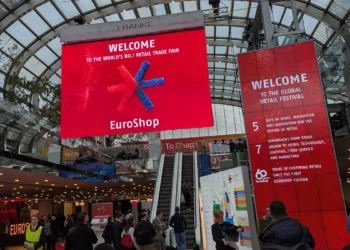
EuroCIS 2026 Retail Technology Market Outlook is emerging as an early barometer for where European retail technology spending may shift next. Scheduled for February 22–26, 2026, at MESSE DÜSSELDORF, Stockumer Kirchstraße 61, 40474 Düsseldorf, North Rhine-Westphalia, Germany, the trade fair arrives at a pivotal moment for the sector. Retailers across Europe are reassessing how to modernize stores and digital channels without undermining profitability, making this year’s gathering more than a routine industry event.
Official event information is available at https://www.eurocis-tradefair.com. As a specialized retail technology trade fair rather than a broad retail expo, EuroCIS functions as a market checkpoint for buyers, vendors, and integrators evaluating which systems are scalable and which remain experimental.
Event Context and Strategic Timing
February Timing and Procurement Cycles
Running from February 22 to February 26, 2026, EuroCIS takes place early in the fiscal year for many retailers. That timing is strategically significant. Early-year events often influence procurement cycles, vendor shortlists, and rollout strategies for the months ahead. Retailers refining 2026 budgets, planning pilot programs, or coordinating multi-country deployments are likely to use insights from Düsseldorf to guide final investment decisions.

The location further reinforces its importance. Düsseldorf is one of Germany’s leading trade fair centers and offers a practical meeting point for pan-European retail discussions. Retail technology decisions increasingly span multiple markets with differing payment ecosystems, tax regimes, logistics networks, and consumer behaviors. Germany’s central role in European commerce makes it a fitting backdrop for cross-border strategy discussions.
A Focused Technology Platform
EuroCIS centers on the technology stack behind modern commerce. Core solution areas include store systems, e-commerce enablement, payment infrastructure, customer analytics, merchandising platforms, and supply chain visibility tools. Although official exhibitor and attendee numbers have not been specified, the expected mix includes retail chains, independent merchants, chief information officers, digital and operations leaders, store technology managers, fintech providers, POS and ERP vendors, CRM and analytics suppliers, RFID and IoT specialists, AI and computer vision firms, logistics operators, consultants, and systems integrators.
That diversity reflects the increasingly cross-functional nature of retail technology investment. A single checkout transformation, for example, can affect payments, loyalty integration, fraud management, labor scheduling, and omnichannel fulfillment simultaneously.
Market Conditions Shaping the 2026 Outlook
From Expansion to Efficiency
The EuroCIS 2026 Retail Technology Market Outlook suggests a more disciplined investment climate compared with earlier waves of digital transformation. Retailers continue to allocate capital to technology, but scrutiny over measurable returns has intensified. Boards and executive teams are prioritizing systems that reduce operating costs, improve inventory accuracy, mitigate shrink, and deliver consistent customer experiences.
This shift favors vendors that can demonstrate integration capability, lower total cost of ownership, compliance with European regulations, and compatibility with existing enterprise systems. Implementation risk is increasingly assessed alongside feature depth. Buyers are expected to challenge suppliers on deployment timelines, governance standards, and long-term scalability.
Omnichannel as Baseline
Omnichannel capabilities—click-and-collect, ship-from-store, mobile checkout, endless aisle, and integrated returns—are now baseline expectations in many retail categories. As a result, differentiation is shifting from availability to execution quality.
Retailers are focusing on near real-time inventory synchronization, improved order routing logic, seamless cross-channel returns, and stronger personalization based on unified customer data. Order management systems, customer data platforms, and store execution software are therefore likely to remain priority areas at EuroCIS 2026.
Solution Areas Drawing Industry Attention
AI and Practical Automation
Artificial intelligence remains central to the EuroCIS 2026 Retail Technology Market Outlook, though the emphasis has shifted from experimentation to applied value. Retailers are concentrating on targeted use cases such as demand forecasting, dynamic pricing, markdown optimization, workforce scheduling, customer service automation, video analytics, loss prevention, and shelf monitoring.
Deployment value is the defining question. Buyers are expected to compare suppliers based on explainability of AI models, speed of implementation, data governance frameworks, and compatibility with legacy systems.
Store automation also continues to gain traction. Physical stores still account for a substantial share of European retail activity, even as digital channels expand. With labor shortages and wage pressures affecting margins, retailers are evaluating self-checkout, assisted checkout, smart carts, mobile scanning, electronic shelf labels, RFID-based inventory tracking, cash automation, digital signage, and computer vision for queue management and shelf analysis.
Payments, Data, and Cybersecurity
Payments remain one of the most commercially sensitive retail technology categories. Retailers are seeking flexible acceptance methods, unified commerce checkout experiences, reduced transaction friction, and improved fraud detection. Support for contactless cards, mobile wallets, buy now, pay later services, and loyalty-linked payment solutions is increasingly standard.
Checkout is also evolving into a strategic data capture point. This aligns with broader first-party data strategies, as retailers attempt to unify transactional and behavioral information across channels. Vendors offering advanced analytics, segmentation, personalization, and customer intelligence tools are likely to attract sustained attention in Düsseldorf.
Inventory visibility is another high-priority area. RFID, IoT sensors, and real-time inventory management platforms are being deployed to reduce stockouts, optimize working capital, and support store-based fulfillment for e-commerce orders. Accurate inventory data is no longer a back-office metric; it directly influences customer satisfaction and revenue capture.
Cybersecurity has moved to the forefront of retail boardroom discussions. Connected stores, cloud-native systems, payment platforms, employee devices, and loyalty databases expand the attack surface. As a result, payment security, identity management, endpoint protection, fraud analytics, and regulatory compliance with European data protection standards are integral components of the retail technology investment agenda.
Commercial and Regional Impact
For exhibitors, EuroCIS 2026 offers concentrated access to enterprise buyers actively comparing vendors and refining technology roadmaps. In a market characterized by disciplined spending, face-to-face discussions can accelerate trust-building and shorten evaluation cycles.
For retailers and systems integrators, the event provides a consolidated view of market maturity. It enables benchmarking across competing solutions and helps decision-makers distinguish between incremental innovation and transformative capability.
The regional economic impact should not be overlooked. Major trade fairs in Düsseldorf contribute to hospitality, transportation, and professional services activity across North Rhine-Westphalia. More broadly, the event reinforces Germany’s role as a hub for European retail technology dialogue.
A Market Checkpoint for 2026 and Beyond
EuroCIS 2026 Retail Technology Market Outlook reflects a sector transitioning from rapid experimentation to strategic optimization. Automation, AI, payments modernization, data unification, and cybersecurity are no longer optional enhancements; they are foundational elements of competitive retail operations.
As retailers balance modernization with margin discipline, EuroCIS 2026 is positioned to shape procurement decisions well beyond its February exhibition dates. In an environment defined by cost pressure, labor constraints, and rising customer expectations, the event serves as a critical inflection point for Europe’s retail technology trajectory in 2026 and the years ahead.

Related Posts