No products in the cart.

Intersolar Middle East Returns April 7-9 2026
Intersolar Middle East Returns April 7–9, 2026 to Dubai World Trade Centre
Intersolar Middle East will return to the Dubai World Trade Centre from April 7 to April 9, 2026, reaffirming the United Arab Emirates’ position as a regional hub for renewable energy and solar innovation. The three-day event will take place at Sheikh Zayed Rd, Trade Centre 2, Dubai, bringing together stakeholders from across the global solar and energy storage value chain.
As part of the broader Intersolar global series, the Middle East edition serves as a strategic meeting point for manufacturers, project developers, utilities, investors, policymakers, and technology providers focused on accelerating the region’s energy transition. Further event details are available via the official website at https://www.intersolar.ae/home.
A Strategic Platform for the Middle East Solar Market
Intersolar Middle East is dedicated to the solar power and energy storage sectors, with a focus on photovoltaic (PV) technologies, solar thermal systems, grid integration, battery storage solutions, and smart renewable energy infrastructure. The event typically features exhibitors spanning module manufacturing, inverter production, mounting systems, energy storage technologies, EPC services, and digital energy management platforms.

The Middle East and North Africa (MENA) region has emerged as one of the world’s fastest-growing solar markets. Governments across the Gulf Cooperation Council (GCC) are advancing ambitious clean energy targets, driven by energy diversification strategies, net-zero commitments, and long-term economic transformation plans such as the UAE’s Energy Strategy 2050.
Against this backdrop, Intersolar Middle East functions not only as a trade exhibition but also as a forum for industry dialogue. It provides a space for addressing regulatory developments, financing models, large-scale solar tenders, grid modernization, and hybrid renewable projects combining solar with storage and hydrogen production.
Dubai as a Regional Energy Innovation Hub
The selection of the Dubai World Trade Centre as the venue underscores the city’s central role in regional business and energy policymaking. Dubai has positioned itself as a testing ground for large-scale renewable energy initiatives, including the Mohammed bin Rashid Al Maktoum Solar Park—one of the largest single-site solar parks globally.
The UAE’s geographic location further enhances the event’s relevance. Situated at the crossroads of Europe, Asia, and Africa, Dubai provides access to emerging markets across the Middle East, South Asia, and East Africa. This strategic positioning supports cross-border investment discussions and regional project partnerships during the event.
By hosting Intersolar Middle East, Dubai strengthens its standing as a convening point for international clean energy stakeholders seeking to enter or expand within the MENA market.
Industry Trends Shaping the 2026 Agenda
Utility-Scale Solar Expansion
The Middle East continues to break records in utility-scale solar procurement, often achieving some of the world’s lowest levelized costs of electricity (LCOE) for photovoltaic projects. Competitive tendering processes in the UAE, Saudi Arabia, and neighboring countries have driven rapid capacity additions.
At Intersolar Middle East 2026, discussions are expected to focus on scaling gigawatt-level installations, supply chain resilience, and balancing rapid deployment with grid stability requirements.
Energy Storage Integration
As solar penetration increases, energy storage has become central to regional energy strategies. Battery energy storage systems (BESS) are being integrated into large-scale solar parks to ensure dispatchability and grid reliability. The event is likely to highlight advancements in lithium-ion technologies, alternative chemistries, and hybrid solar-plus-storage projects.
Energy storage also plays a growing role in industrial decarbonization and off-grid applications, particularly in remote oil and gas operations transitioning to cleaner energy sources.
Green Hydrogen and Sector Coupling
The Gulf region is actively investing in green hydrogen production, leveraging abundant solar resources to power electrolysis. Intersolar Middle East provides a relevant forum for examining how solar infrastructure underpins hydrogen ambitions and broader sector coupling strategies.
The convergence of solar generation, storage, and hydrogen production reflects a shift from standalone renewable projects to integrated energy ecosystems.
Exhibitors and Attendee Profile
Intersolar Middle East typically attracts a diverse range of exhibitors, including:
– Solar module and cell manufacturers
– Inverter and power electronics providers
– Energy storage system suppliers
– EPC contractors and project developers
– Engineering consultancies and grid solution providers
– Financial institutions and infrastructure investors
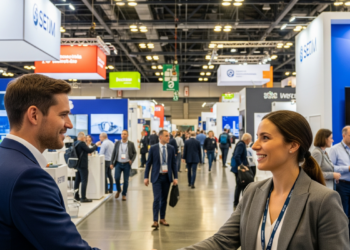
Attendees often include utility representatives, government officials, policymakers, procurement managers, commercial and industrial energy buyers, and technology integrators. The event serves as a networking environment for negotiating supply agreements, forming joint ventures, and exploring project financing structures.
Given the increasing scale of renewable projects in the region, participation from sovereign wealth funds, regional utilities, and international infrastructure investors has become more prominent.
Economic and Strategic Significance
The return of Intersolar Middle East in April 2026 aligns with a critical period for the global energy transition. Volatility in fossil fuel markets, evolving climate policies, and heightened energy security concerns have accelerated investments in renewables worldwide.
For the UAE and neighboring countries, renewable energy expansion is not solely an environmental objective but a core economic strategy. Diversification away from hydrocarbon dependency, development of domestic manufacturing capabilities, and job creation in clean energy sectors are central policy goals.
Trade events such as Intersolar Middle East contribute to this strategy by facilitating technology transfer, attracting foreign direct investment, and supporting local supply chain development. They also enable regional companies to benchmark against international standards and innovations.
Moreover, the event reinforces the UAE’s diplomatic positioning in global climate discussions by demonstrating tangible progress in renewable deployment and industry collaboration.
Market Outlook Beyond 2026
The outlook for the Middle East solar market remains robust. Analysts project continued double-digit growth in installed solar capacity across the GCC over the coming decade. Falling technology costs, improved financing mechanisms, and policy clarity are expected to sustain momentum.
At the same time, challenges persist. Grid integration, intermittency management, land use considerations, and supply chain constraints will require coordinated responses from regulators and industry leaders. Forums such as Intersolar Middle East play a critical role in addressing these complexities through knowledge exchange and cross-sector collaboration.
As the event returns to the Dubai World Trade Centre from April 7–9, 2026, it is set to reflect both the progress achieved and the challenges ahead in the regional and global solar industry. By convening stakeholders at a pivotal moment for energy transformation, Intersolar Middle East continues to serve as a barometer for the evolving renewable energy landscape in the United Arab Emirates and beyond.

Related Posts